Author name: Ella De La Cruz

Back-to-school shopping budget with school supplies and savings
Press

Back-to-School Shopping Without Breaking Your Budget

Back-to-school shopping can get expensive quickly. Between new clothes, school supplies, backpacks, and registration fees, families can end up spending more than they originally planned.

Preparing for a new school year, however, doesn’t have to mean buying everything brand new.

In an August 2026 interview with ARC Salt Lake, BookSmarts founder and CEO Jenny Groberg shared five practical ways families can prepare for the school year while keeping their spending under control.

1. Check What You Already Have Before Shopping

Before heading to the store, take inventory of what your children already own.

Go through their clothes, shoes, backpacks, and school supplies. Make sure everything is clean and organized so you can see what still fits, what can be reused, and what actually needs replacing.

You might discover that last year’s backpack only needs a good cleaning or that the graphing calculator you were about to purchase is already somewhere in the house.

Once you’ve checked what you have, make a shopping list and stick to it. This can help prevent unnecessary purchases and keep you focused on what your children need.

2. Set a Budget Before You Start Spending

Decide how much your family can comfortably afford before going shopping.

Your budget should reflect your household’s finances and the number of children you’re shopping for.

Jenny also recommends involving children in the budgeting process. Giving them a set amount to work with helps them understand that choosing one expensive item may mean spending less on something else.

For example, if your child wants a particular pair of name-brand shoes, they may need to reuse some clothing or shop at thrift stores to stay within their budget.

It’s a practical way to teach children how to prioritize their spending.

3. Don’t Go Into Debt for School Supplies

School supplies and clothing are necessary expenses, but they shouldn’t create months of financial stress.

Jenny advises families to avoid financing back-to-school purchases through credit cards or Buy Now, Pay Later programs.

A backpack purchased in August shouldn’t still be putting pressure on your budget when holiday expenses arrive in December.

Focus on what you can afford now, and prioritize the items your children need to start the school year.

4. Shop Smart, Not Fast

Back-to-school sales can be tempting, but a discount doesn’t automatically make something a good purchase.

Take time to compare prices across stores and websites. If your child wants something that isn’t immediately necessary, consider leaving it in your online shopping cart for a few days before deciding.

That extra time can help separate an impulse purchase from something they genuinely want or need.

Jenny also suggests being mindful of growth spurts. If your child is likely to outgrow their clothes soon, it may make more sense to buy a few essentials now and purchase the rest later.

There’s no need to buy everything at once.

5. Remember the Hidden School Expenses

Clothing and supplies aren’t the only costs families face when school starts.

Registration fees, sports uniforms, school pictures, field trips, dances, and extracurricular activities can add up quickly.

These expenses are easy to overlook when you’re focused on checking items off a school supply list.

Plan for them as part of your overall back-to-school budget.

For older children, Jenny also suggests discussing which expenses parents will cover and which ones children may be responsible for. This can help them develop a better understanding of financial responsibility.

A Little Planning Can Make a Big Difference

Back-to-school shopping doesn’t have to be a financial scramble.

Taking inventory, setting spending limits, shopping thoughtfully, and preparing for additional school expenses can help families make the most of their money.

It’s also an opportunity to teach children valuable financial habits they can carry into adulthood.

Jenny discusses these budgeting strategies and shares examples from her own family’s back-to-school shopping experiences in her August 2026 ARC Salt Lake interview.

Watch the full interview: Back-to-School Shopping Tips with Jenny Groberg | ARC Salt Lake

Sports betting financial risks and warning signs
Press

The Financial Cost of Chasing the Next Win

Sports betting has become easier to access, making it possible to place a bet and follow the outcome right from your phone. What starts as entertainment, however, can become much harder to control.

In a recent ARC Salt Lake interview, BookSmarts founder and CEO Jenny Groberg discussed how sports betting can affect more than the money being wagered. Small bets can add up, early wins can create overconfidence, and the desire to recover a loss can lead to even more betting.

Early Wins Can Create False Confidence

Winning early can make betting seem easier than it actually is.

Jenny shares the example of an 18-year-old who believed he was particularly good at placing bets after having some early success. That confidence made betting feel less risky and encouraged him to continue.

A few wins can create the impression that you’ve figured out a system. But past wins don’t guarantee what will happen with the next bet.

Small Bets Can Add Up

A sports bet may start as part of an entertainment budget. The problem comes when the amount being spent gradually increases.

Jenny explains that people may begin with relatively small bets, only to find themselves placing much larger wagers later. Losses can also create pressure to bet again in an attempt to get the money back.

When betting starts taking money away from rent, groceries, retirement, debt payments, or other financial priorities, entertainment has become a financial problem.

Chasing Losses Can Make Things Worse

Losing money can make walking away difficult.

Instead of accepting the loss, someone may increase the next bet hoping to break even. Jenny identifies this pattern of chasing losses as one of the warning signs that betting is becoming unhealthy.

At some point, the better financial decision may simply be to accept the loss and stop putting more money at risk.

Look Beyond the Money

The cost of sports betting isn’t limited to the amount lost on a wager.

Jenny shares examples of people spending significant amounts of time monitoring their bets, including a CEO who was spending six to seven hours a day watching them. That raises another important question: What else could that time and attention have been used for?

Betting can affect work, family time, relationships, and personal well-being when following the next wager becomes a constant focus.

Know the Warning Signs

Some behaviors can indicate that sports betting is no longer simply entertainment.

Increasing the size of bets after losing, repeatedly trying to win back losses, using credit to place bets, hiding gambling accounts from a spouse or partner, and constantly monitoring bets are all warning signs discussed during the interview.

Recognizing those patterns early can help prevent betting from taking money and attention away from the financial priorities that matter most.

Sports betting may promise excitement and the possibility of a win, but every wager comes with financial risk. Understanding how those decisions can build over time is an important part of protecting your budget and long-term financial goals.

Jenny shares more about the financial and behavioral warning signs of sports betting in her full conversation with ARC Salt Lake.

Watch the full interview: ARC Salt Lake discussion on the financial risks and warning signs of sports betting.

Watch the full ARC Salt Lake interview on YouTube

Press

When Smaller Payments Lead to Bigger Spending

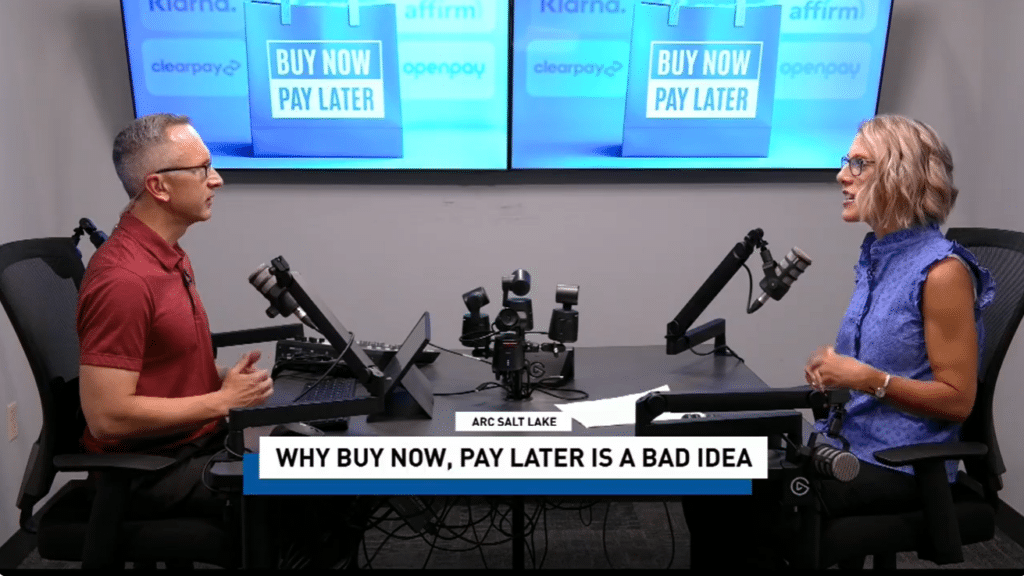
Buy Now, Pay Later services are everywhere. At checkout, a $200 purchase can suddenly feel more manageable when it becomes four payments of $50.

That convenience is exactly what can make these services risky.

In a recent ARC Salt Lake segment, BookSmarts founder and CEO Jenny Groberg discussed how Buy Now, Pay Later programs work and why seemingly manageable payments can create problems for your budget, spending habits, and long-term financial goals.

Small Payments Can Make It Easier to Overspend

Breaking a purchase into smaller payments can make the cost feel less significant. Instead of thinking about the full price, you’re focused on what you have to pay today.

Jenny explains that this can take some of the sting out of spending and make it easier to buy more than you originally planned. The problem becomes even harder to manage when several purchases are being paid off at the same time.

A few payments here and there may not seem like much. But once they start hitting your bank account together, they can compete with money needed for groceries, gas, rent, and other essential expenses.

Convenience Can Encourage Impulse Buying

Online shopping is designed to make purchasing easy. Buy Now, Pay Later adds another layer of convenience by removing the need to pay the full amount immediately.

Jenny recommends doing the opposite: slow the purchase down.

She follows a 24-hour rule and uses the same approach with her children. When something catches their attention, they wait at least a day before deciding whether to buy it.

That extra time gives you a chance to ask a simple question: Do I actually want or need this, or am I caught up in the moment?

Returns Can Complicate Your Cash Flow

Returns can also become more complicated when a purchase is split across several payments.

Even after returning an item, another scheduled payment could potentially be drafted before the Buy Now, Pay Later provider processes the return and credit. Jenny points out that this timing difference can create additional disruption to your cash flow.

It’s another reminder that a convenient checkout option can create more financial tracking behind the scenes.

Focus on What You Can Actually Afford

One of Jenny’s main recommendations is straightforward: if you can’t afford to pay for a regular purchase upfront, reconsider whether you should make the purchase right now.

Using delayed payments doesn’t change the actual price. It only changes when the money leaves your account.

And when several future payments are competing for the same paycheck, it becomes harder to stay on top of the bills and expenses that matter most.

Give Yourself 24 Hours

You don’t have to make every purchasing decision immediately.

Jenny explains that shopping can have an emotional component. We may believe a purchase will make us look better, feel better, or help us accomplish something we want.

Waiting 24 hours gives some of that initial excitement time to fade. Then you can come back to the decision and ask whether the purchase still makes sense for you and your budget.

Sometimes, one day is all it takes to realize you didn’t really need it after all.

Jenny shares more about Buy Now, Pay Later services and ways to make more intentional purchasing decisions in her full conversation with ARC Salt Lake.

Watch the full interview: Buy Now, Pay Later discussion with Jenny Groberg of BookSmarts Accounting.

Watch the full ARC Salt Lake interview on YouTube

How to get out of debt and stay out
Press

Getting Out of Debt Takes More Than Earning More

When debt feels overwhelming, it can be easy to think the solution is simply making more money. But earning more doesn’t automatically change the habits that created the debt in the first place.

In a recent WAVE 3 News Make Ends Meet feature, BookSmarts founder and CEO Jenny Groberg shared practical strategies for paying down debt and building habits that can help people stay out of it. She also shared her own experience of paying off student loans with her husband in about two and a half years.

Start With the Choices You Can Control

Jenny and her husband made paying off their student loans a priority. As their income increased, the extra money went toward their debt instead of upgrading their lifestyle.

That meant keeping their cars, skipping unnecessary extras, and focusing on their bills.

It wasn’t necessarily the easiest choice, but it allowed them to make meaningful progress much faster than stretching their student loan payments over many years.

Know Where Your Money Is Going

If you want to get out of debt, you need a clear picture of what is coming in and what is going out.

Jenny recommends having a budget and tracking what you actually spend. She also emphasizes understanding the difference between needs and wants.

A budget may feel restrictive at first, but it gives you information. Once you know where your money is going, you can make more intentional decisions about what to keep, what to cut, and what can go toward paying down debt.

Keep the Long Game in Mind

Paying off debt takes time, which makes it important to remember why you started.

Jenny suggests tracking your progress and finding ways to keep your goal visible. That might be as simple as regularly checking your balances or creating a vision board that reminds you what financial freedom could make possible.

She also recommends paying yourself first. Getting rid of debt is important, but saving should still be part of the bigger financial picture.

Be Careful With Comparison

Sometimes the pressure to spend doesn’t come from what we actually need. It comes from seeing what everyone else appears to have.

Social media can make that harder. Someone else’s new house, car, vacation, or purchase can quickly make you feel like you should have the same thing.

Jenny points out that social media only shows part of the picture. Comparing your financial life to what someone chooses to share online can lead to spending decisions that have nothing to do with your own priorities.

Build Habits That Last Beyond the Debt

Paying off the final balance is a major accomplishment, but staying out of debt requires many of the same habits that helped you get there.

Know where your money is going. Spend according to your priorities. Save for the future. And when your income increases, think about what you want that additional money to accomplish before automatically increasing your spending.

Getting out of debt isn’t about doing everything perfectly. It’s about making intentional financial choices consistently enough to move toward the life you want.

Jenny shares more of her personal experience and practical tips for paying down debt in the full WAVE 3 News Make Ends Meet feature.

Read the full feature: Make Ends Meet: How to get out and stay out of debt.

Read Jenny Groberg’s full feature on WAVE 3 News:
WAVE 3 News – Make Ends Meet: How to Get Out and Stay Out of Debt

Building company culture from the top down featuring Jenny Groberg
Press

Company Culture Starts With Leadership

Company culture isn’t built by simply writing down a set of values. It takes shape through the decisions leaders make, how they communicate, and how they treat their people every day.

In a recent Authority Magazine interview, BookSmarts founder and CEO Jenny Groberg shared how her approach to leadership has shaped the culture at BookSmarts—and what she has learned about building company culture through growth, change, and challenging seasons.

Values Have to Show Up in Your Decisions

For Jenny, one of the defining values at BookSmarts is fearlessness. But living a company value means more than talking about it.

Leaders eventually face decisions that test what they say they believe. Jenny shared examples of choosing her employees’ well-being over revenue and opportunities when the two were in conflict.

Those decisions send a message to the team: the values of the company still matter when following them isn’t convenient.

Make It Safe to Ask for Help

A strong culture also gives people room to say when they don’t know something.

At BookSmarts, regular one-on-one meetings, team communication, and opportunities to ask questions help employees get support when they need it. Instead of treating questions as weaknesses, the goal is to make them part of learning and collaboration.

When people feel comfortable asking for help, they can solve problems together instead of struggling with them alone.

Communicate Through Change

Change can create uncertainty, especially when a company is growing.

Jenny emphasizes communicating early and openly about what is changing, why it is happening, and what the plan is moving forward. Giving people that context helps them understand the bigger picture instead of leaving them to fill in the blanks themselves.

That transparency has been especially important as BookSmarts has grown its team and created new employment and development opportunities.

Believe in Your People

Another part of building company culture is showing people that you trust them.

Jenny shared that during a major transition, she made a deliberate effort to communicate confidence in her COO and team. When leaders show that kind of trust, it gives employees room to step up, take ownership, and grow into what they’re capable of doing.

As Jenny explains in the interview, people often rise to the level of encouragement and confidence placed in them.

Build a Team-First Culture

The strongest company cultures aren’t built around one person succeeding.

At BookSmarts, the focus is on what the team can accomplish together. Jenny describes a culture where employees ask how they can help one another and recognize that supporting another team member ultimately helps everyone—including the clients they serve.

That team-first approach is also connected to a larger purpose. Jenny wants BookSmarts to create meaningful work and opportunities for people, particularly those who may need additional support or confidence as they build their careers.

Culture Is Built Every Day

There isn’t one meeting, policy, or statement that creates a strong company culture.

It comes from consistently showing people what matters through everyday decisions—protecting your team, communicating honestly, asking for feedback, trusting people to grow, and being willing to make changes when something isn’t working.

Jenny shares more about the experiences that shaped her leadership and her five recommendations for building a thriving company culture in her full interview with Authority Magazine.

Read the full interview: Building Company Culture From the Top Down: Jenny Groberg Of BookSmarts Accounting On How the Personal Example of Exceptional Leaders Shapes Companies That Thrive.

Read Jenny Groberg’s full interview in Authority Magazine

Prediction markets and investing graphic illustrating the difference for business owners
Press

When Prediction Markets Look Like Investing—but Aren’t

Prediction markets are becoming easier to access, and the way they’re presented can make placing a wager on an outcome feel surprisingly similar to making an investment.

In her article for Inc., BookSmarts founder and CEO Jenny Groberg explains why business owners should understand the difference—and why it matters when deciding where to put their money.

Prediction Markets Can Look a Lot Like Investing

Prediction markets let people put money behind whether they think a future event will happen. That could mean an election result, an economic decision, a sporting event, or another real-world outcome.

It’s easy to see why they can feel like investing. You research an outcome, form an opinion, put money behind it, and potentially make money if you’re right.

But there’s an important difference. Investing typically means putting money into an asset or business that has the potential to grow or create value over time. With a prediction market, you’re putting money on whether a specific event will happen.

The financial language may sound familiar, but the underlying activity isn’t the same.

Don’t Forget the Tax Side

There’s also the practical side of what happens when money changes hands.

Jenny points out that the tax treatment of prediction-market activity can depend on the circumstances. That makes good recordkeeping important, especially if someone participates regularly or has significant gains and losses.

For business owners who already have plenty to keep track of financially, it’s worth understanding what you’re getting into before assuming it works like a traditional investment account.

What Else Could That Money Be Doing?

For entrepreneurs, there’s another question worth asking: What else could I be doing with this money?

The same dollars could go toward hiring or developing employees, purchasing equipment, marketing the business, building savings, contributing to retirement accounts, or investing in something with the potential to create long-term value.

And it isn’t only about money. Time and attention have value too.

That doesn’t mean every financial decision has to generate a return. But business owners should understand what they’re choosing—and what they may be giving up in exchange.

Know What You’re Putting Your Money Into

Prediction markets can be entertaining, and getting a prediction right can certainly feel rewarding. But that doesn’t make them the same as investing.

Understanding the difference between betting on an outcome and investing in something that can grow can help business owners make more intentional decisions about where they put their money, time, and attention.

Jenny explores prediction markets, their financial and tax considerations, and what entrepreneurs should think about before participating in her full article for Inc.

Read the full article: Prediction Markets Make Betting Feel Like Finance. It’s Not.

Read Jenny Groberg’s full article in Inc.

Jenny Groberg featured on the Sweet Takes Big Leap Podcast
Press

What Playing the Long Game Really Looks Like in Business

What does playing the long game in business actually look like when growth isn’t the only thing you’re trying to accomplish?

BookSmarts founder and CEO Jenny Groberg joined the Sweet Takes – Big Leap Podcast for a conversation about growing BookSmarts, creating opportunities for accounting professionals around the world, making better financial decisions, and some of the experiences that have changed the way she approaches both business and life.

A recurring idea throughout the conversation was simple: play the long game.

Growth Starts With Thinking Bigger

BookSmarts is at a point where Jenny sees significant opportunity for growth. But taking on more work means making sure the team has enough depth to support that growth without exhausting the people already there.

That has pushed her to think differently about hiring and training.

During the episode, Jenny talks about BookSmarts’ work with BYU Pathway, which began with a 10-week accounting course taught with the help of members of the BookSmarts team. As the program grew, so did the opportunity to identify talented people who had completed the training and were looking for meaningful work.

BookSmarts has since hired six people through the program.

Getting there wasn’t necessarily the easiest or least expensive option. Jenny shares that establishing the cybersecurity infrastructure alone required a significant investment, and some people questioned whether the initiative made financial sense.

Jenny saw it differently.

The immediate cost was only one part of the equation.

Sometimes the Best Investment Doesn’t Pay Off Immediately

One of the most interesting parts of the conversation is Jenny’s explanation of why she was willing to make that investment.

Giving back is one of the pillars of BookSmarts. Helping people develop accounting skills and improve their employment opportunities had value to Jenny regardless of whether every participant eventually worked for BookSmarts.

But there was a business lesson in it, too.

Hiring and training are expensive. Turnover creates more training. And when people working on client accounts change frequently, clients feel that disruption.

Jenny’s longer-term goal is to develop people who are well trained, supported, and hopefully interested in staying for years.

That is where the long game comes in.

An investment that looks expensive today can make sense when you consider the stability, capacity, and opportunities it could create several years from now.

Your Numbers Should Tell You When Something Needs to Change

The conversation eventually comes back to accounting and why Jenny believes financial information matters so much to business owners.

Her advice is practical: don’t run a business based only on whatever problem feels most urgent that day.

Look at the numbers.

Jenny encourages business owners to regularly review reports such as their balance sheet, profit and loss statement, cash flow, and sales by customer. She also recommends comparing multiple periods so changes and outliers are easier to spot.

If payroll suddenly increases while revenue stays flat, for example, that’s information you can act on. Maybe pricing needs to change. Maybe overtime is signaling that it’s time to hire. Whatever the answer is, the financials help identify the problem before the business owner is forced to simply react to it.

Good accounting isn’t only about documenting what already happened.

It’s about having enough information to make a better decision about what happens next.

Small Progress Still Counts

Jenny also shares a much more personal side of her story during the episode.

After a brain injury significantly affected abilities she had previously relied on, recovery forced her to rethink what progress looked like. Pushing harder didn’t necessarily make things better. In some cases, it made recovery worse.

That experience changed the way she thinks about growth.

Instead of expecting everything to happen through one massive effort, Jenny has learned to recognize the value of small gains repeated over time.

That lesson now shows up in the way she talks about business, leadership, and even the advice she gives her children: you don’t have to be perfect. You have to keep showing up.

Progress over perfection.

What Does Playing the Long Game in Business Look Like?

There isn’t one answer.

It can mean investing in people before you desperately need them.

It can mean making a decision that doesn’t produce an immediate financial return because you understand the broader value it can create.

Or it might mean looking at three months or three years of financial results instead of reacting to one difficult week.

And sometimes, it simply means continuing to show up and allowing small improvements to compound.

Jenny’s conversation on Sweet Takes goes well beyond accounting. It’s a candid discussion about growth, resilience, giving back, leadership, and what can happen when you stop measuring every decision by its immediate payoff.

Watch or listen to the full conversation:


Scroll to Top

VIP Guide Request

This field is for validation purposes and should be left unchanged.
Name(Required)
Email(Required)
By submitting this form you are agree to the storage and handling of your data by this site.

Request FINAL FIVE eBook

This field is for validation purposes and should be left unchanged.
Name(Required)
Email(Required)
By submitting this form you are agree to the storage and handling of your data by this site.

Services Access

This field is for validation purposes and should be left unchanged.
Name(Required)
Email(Required)
Privacy(Required)
BookSmarts
Privacy Overview

This website uses cookies so that we can provide you with the best user experience possible. Cookie information is stored in your browser and performs functions such as recognising you when you return to our website and helping our team to understand which sections of the website you find most interesting and useful.